Start Here: the HAUNTS
How to enjoy my serialized ghost story compendium: The HAUNTS

Welcome to The Haunts: Fearsome Legends from the American South
This is the “start here” Table of Contents for the serial online version of the limited-edition book Haunts: Fearsome Legends from the American South.
This post is being released Monday, April 6, 2026, and below you will find the TOC and the Intro, which will remain public, and free to read.
Installations will come out every Monday, and will be free/public for one week. On the following Monday, a new one will come out and the previous will move into the permanent archive for paid subscribers only.
Thank you for joining me on this journey of ghosts, monsters, haunted places, and devilish things… I sure wouldn’t want to wander into it alone.
Table of Contents
* If the item below is not yet hyperlinked, it means that story has not yet posted.
Part 1, Echoes of Grief: Spirits That Were Once Human
Helen Johnstone >
Pearl Bryan >
Pink Lizzie >
Hazel Farris >
The Candlelight Spirit >
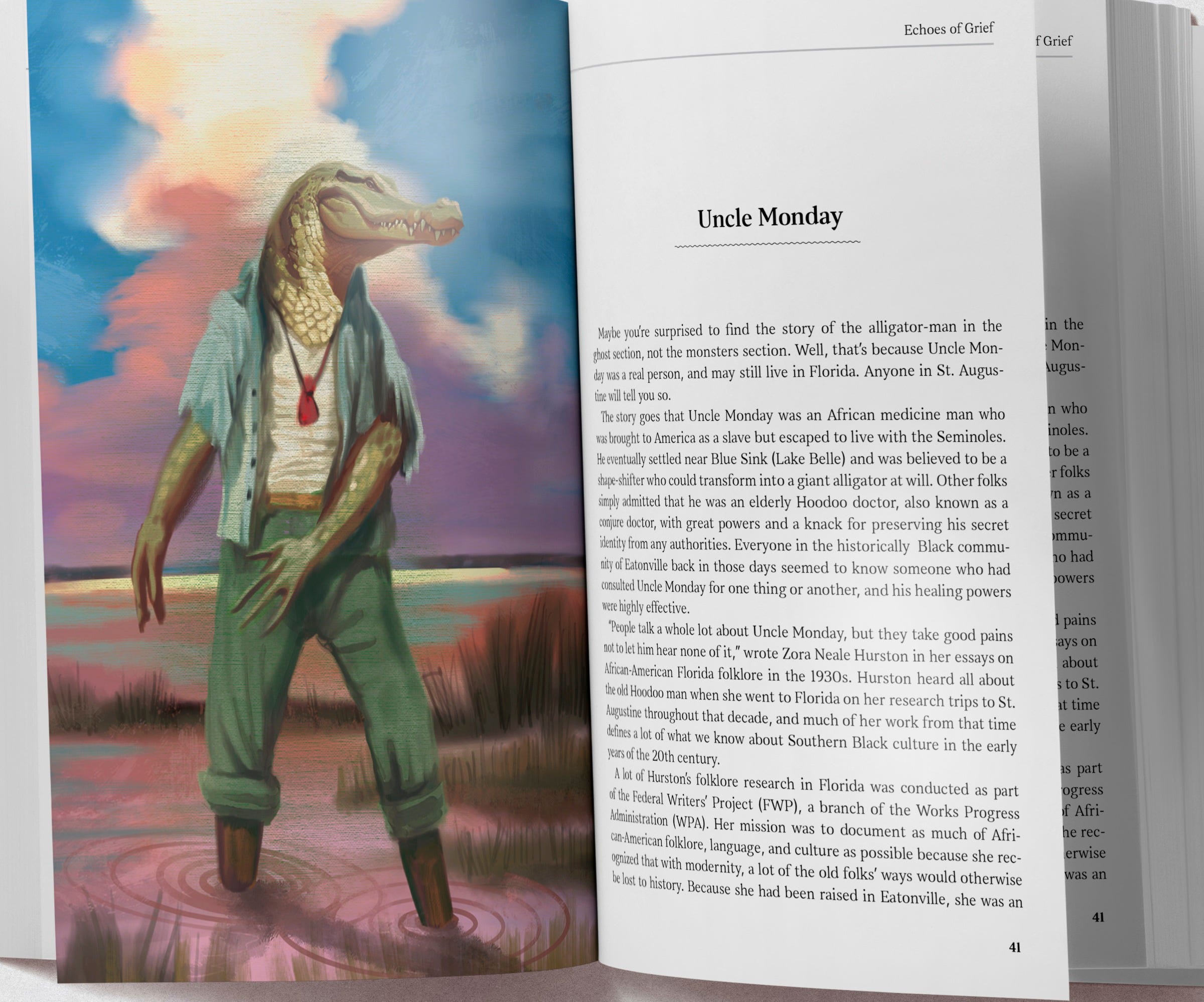
Uncle Monday >
Part 2, The Lamp’s Eerie Glow: Spooky Places and Objects
The Crescent Hotel
Sloss Furnaces
The Poinsett Bridge
Lunatic Asylum
Sweetwater Mansion
Ghost Garden
Part 3, Waiting in Ambush: Monsters, Creatures, and Cryptids
Rougarou
Mothman
Wampus Cat
Hicklesnoopus
Boo Hag & the Plat Eye
Tailybone
Part 4, Marks of the Profane: Unclean, Devilish Things
Conjured Spirit
Yazoo Witch
Bell Witch
Hellhound
The Casquette Girls
The Devil
Introduction
This book is the natural expansion of the research I did for my oracle deck called the HAUNTS Oracle, starting in 2021 and expanded in 2025. That oracle deck is what some might call a fortune-telling deck of cards—and a dark one at that—designed with one frightful story on each card face. The idea behind it is to draw a card, and then either guess what you think it might mean to you or look up the story in the accompanying guidebook.
I based each card on a real legend from the American South, and I tried to include everyone. From the far northern reaches of our area in the tippy-top of West Virginia, all the way down to the swamps of Louisiana and Florida, I found hundreds of chilling tales that really lived up to the concept of Southern Gothic. For the purposes of making a card deck, I curated it down to just the ones that I thought carried an interesting foreshadowing of a person’s fate, or maybe a feeling they might be having. For example, if you draw a card with Mothman on it, maybe you ought to consider the ways you’ve been retreating from society. After all, says the guidebook, if you hide too long away from the light, you raise the risk of losing what makes you human.
This is just something we do here.
On a recent vacation to South Carolina, my partner and I stumbled time and again on attractions that offered thrills and chills. “The Only Haunted Carriage Tour,” boasted one brochure. “Book now for a spooky night you’ll never forget.” In my hometown of Memphis the historic Elmwood Cemetery not only has guided tours with themes like “Scandals & Scoundrels,” it even offers movie night, in which we all spread quilts and munch on snacks in order to keep the spirits company.
Of course New Orleans, not to be outdone by any city anywhere, has a Vampire Café with cocktails called The Bloodiest Mary. The Crescent City’s macabre attractions are too numerable to list. There’s even a Museum of Death in New Orleans.
Bookstores throughout this area are filled to bursting with books (like this one) titled Ghosts of Old Kentucky and Florida’s Haunted Hospitality. I was grown before I decided that although this phenomenon exists in other American states and even overseas, there simply does not seem to be any culture anywhere as preoccupied with death and scary things as we are here in the American South. It’s a pastime, it’s a lifestyle, and it fuels our tourism industry. Where would a Southern Gothic novel be without shrieking ghosts in the attics and wooly beasts in the forests?
Ultimately I found that I was in possession of too much juicy information to keep these legends contained in the tiny little guidebook that accompanies the cards in their box. I wanted to share the longer versions of the stories with you, just for their own sake.
All of these books about ghosts in Southern states, my own included, reveal an awful lot more about the readers than they do about the legends’ face value. There are many discussions about the nature of fairy tales, and what they say about bigotry, misogyny, and prejudice. One of those points concerns the predominance of ghosts who are tragic women: nearly always white, surely young and beautiful, forlorn because of a lost lover, baby or husband. There is only one of those in this book: The Bride of Annandale, based on the legend of Helen Johnstone. I included her precisely because I needed one to would represent the innumerable “women in white” ghost stories that pump like oxygenated blood through the veins of folkloric literature down here. And what about the stories of wandering, dead Confederate soldiers — could those have more to do with the myth of the Lost Cause than any actual specters out her bothering anyone?
(Checklist: I also needed a haunted house that wasn’t really there, monsters in the woods, some demons, and a couple of witches. I found loads of them; just you wait.)
I chose each of these stories not only because they are sordid and dramatic, but also to reveal a little something about those of us who tell these tales. Forgive the Southern mom in me, but damn if I don’t love a hearty lesson at the end of a bedtime story. In Part 1, we examine stories of ghosts who were once human. In Part 2, we’ll visit haunted places and objects. Part 3 concerns beasts and cryptids lurking in the dark, and lastly, in Part 4 we penetrate the nexus of darkness itself: the profane.
The “shadow” is a term from Jungian psychology, and it refers to the parts of ourselves that are often troublesome, maybe even one might call them personality flaws… but which are there following us, because they are a fundamental part of our soul’s makeup. Our shadowy tendencies are best dealt with and tamed when we face them head on, instead of ignoring or denying that the shadows exist. They stem from our personal traumas and shortcomings, but they also give rise to very real fears— and sometimes fears are valid because they keep us reasonably cautious in the face of danger. We all have both a light side and a dark side, depending on which way the sun is shining.